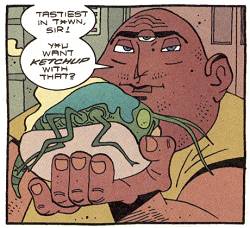
Remember how, ages ago, I met Gilbert Shelton at his studio in Paris? Well. I finally wrote it up for The Comics Journal.
Showing posts with label interviews. Show all posts
Sunday, 17 February 2013
Monday, 31 January 2011
Mike McMahon

In the early nineties, Jim Boswell and me walked into a Macclesfield pub with photocopied, stapled issues of 'Weird City', our first self-produced comic, and amazingly - they sold.
If I ever get around to it, I'll scan a few copies and put them up here.
My contributions dwindled to nothing almost immediately - leaving Jim as editor for the rest of the five (or was it six?) issue run. And as I buggered off to University, he started attending 'graphic narrative' courses (or whatever they were called) in Manchester. Soon, a whole bunch of brilliant new people were contributing.
Weird City ended up being called 'a potential jewel in the small press crown' in some review or other, and, by the time the thing folded, Jim had even managed to convince Glenn Fabry to draw a cover, gratis, after interviewing him about his work.
I'll transcribe that interview another time, but for now, here's an interview that was printed with the fantastic Mike McMahon - a huge influence on many of the cartoonists I've spoken to who, like me, had religiously bought 2000AD as a kid.
(The interview was by Peter Walker, by the way. Some time in '93).
Weird City: How did you first get into comics?
Mike McMahon: I sent some samples to the War Picture library editor, and he thought they were alright, but he didn't want to use them. So he sent me round to an agent, who was a nice middle class guy who assumed my name was Mike. Everyone really calls me Mick. I didn't want to upset him so I said 'yeah, that's right. My name's Mike.' I've been stuck with that ever since! But he did get me into 2000AD.
WC: What was your favourite 2000AD character to work on?
Mike: Slaine. It was the first one I did where I thought I knew what I was doing. Looking back I don't think I did, but I thought I did so I enjoyed it a lot more than the other things. Usually when I draw things I worry all the time. For every line I make, I've rubbed out a dozen.
WC: the artwork you did on Slaine seemed to be more 'your style'. Did you have to adopt a cleaner style for Judge Dredd? Did they make you do that?
Mike: No. No-one's ever made me do anything. That's why I like working for Fleetway or IPC. I can really do what I like. Whereas when I've been working for America, the people who are managing the companies have all got their own opinion. They get a lot of 'house-styles' in America.
Well, they used to. I don't really look at any comics now, but I imagine they do with a lot of these 'X Comics' they bring out. These 'Image Comics' or whatever.
Mike: No. No-one's ever made me do anything. That's why I like working for Fleetway or IPC. I can really do what I like. Whereas when I've been working for America, the people who are managing the companies have all got their own opinion. They get a lot of 'house-styles' in America.
Well, they used to. I don't really look at any comics now, but I imagine they do with a lot of these 'X Comics' they bring out. These 'Image Comics' or whatever.
WC: With Slaine, your technique seemed to go more and more towards an almost 'pencil' style. Was that planned, or did it just happen?
Mike: No. I was drawing that and I totally lost confidence - and I could only draw on tracing paper! I'd do a drawing and trace it onto tracing paper and then mount it down. And I noticed all these little white gaps, so I thought I'd better carry on doing it like that.
Eventually I got to the point where so much of my stuff was being reprinted in colour that I thought 'I know, I can play this up' and make it impossible for it to be reprinted in colour. Which it was!
WC: How do you feel when characters like Slaine change with other artists. For example, your Slaine and Simon Bisley's look like two different people!
Mike: Yeah, well, Bisley's a much better artist than me, so it's bound to be different! He's a painter isn't he? An illustrator. I quite like seeing things done differently by other artists. It usually gives me new ideas as well - not that I copy them.
WC: What are you working on at the moment?
Mike: Well, I was doing a thing called 'Tattered Banners' for Vertigo, written by Keith Giffen, but the script apparently fell down the back of a bureau! And after a lot of excuses for three or four weeks, nothing arrived, so I've started doing Judge Dredd again. I've had the script since October. When I've done that, I'll go back to Tattered Banners.
WC: Who wrote the Dredd story?
Mike: John Wagner. It's very good; very funny. I think that's what's missing a lot of the time with new material these days. The trouble with many new people is that the do a script and they think that makes them a writer.
I mean, I never try to write because I could never reach the standards that should be achieved. But that doesn't seem to bother a lot of people.
WC: So what, to you, is a good standard of writing?
Mike: Well, it's hard to put your finger on it. But to me, it's someone who would never think of drawing a comic. Someone like John Wagner, who isn't really interested in the 'comics scene'. The standards he achieves are very personal - obviously they don't come across like that - but they reflect his weird sense of humour.
WC: Don't you think the bad guys in Judge Dredd are often more interesting than Dredd himself?
Mike: That's always been the case. When John created the thing, Dredd quickly became a dull, boring character - just shooting and killing people. John was interested in the people that lived in the city: not just the villains, but the general population - the fat people, and things like that.
They're all just eccentrics, because of where they live and the time they live in. I think the style of the script was that Dredd was a clone, a machine, or whatever you want to call him. And the emphasis was really on his victims.
That was quite a good formula, but now they've muddied the waters by trying to make Dredd an interesting character. But you can't have an interesting character if you can't see his face!
They're all just eccentrics, because of where they live and the time they live in. I think the style of the script was that Dredd was a clone, a machine, or whatever you want to call him. And the emphasis was really on his victims.
That was quite a good formula, but now they've muddied the waters by trying to make Dredd an interesting character. But you can't have an interesting character if you can't see his face!
Mike: No! I don't even know if there is a film. Is there? I suppose that whoever is going to be Dredd isn't going to want to wear a helmet all through the film are they? I mean, it could be anybody under there. He even wears it in bed!
Mike: Chuck Dixon.I thought I'd get on the bandwagon! For the first time in my life I'd do this just to get some money! Apparently the storyline clashed with another Batman story by Mark Badger. I've never seen it, but it's a very similar plot, which has never happened before in American comics! So mine had to be shelved.
WC: What do you think about artists who have imitated your style, or stolen some of your images?
Mike: I don't mind that. I don't like it when they trace things, though. You know, it took me a day to draw and it takes them ten minutes. They turn up in a lot of places. They fool me, I'll tell you! I can't see the point of copying things - you might as well go and work on the Stock Exchange. All they want is money, don't they? There's no fun in it.
WC: Is there anything personally that you'd like to work on?
Mike: No. My attitude tends to be that there are things I don't want to work on. I know what I can't do, like love stories. Or sports comics!
Whatever I'm doing, I want to find something that I can get out of it. I usually spend about a month wrestling with how I want to present a new story. Which means I'm not making much money a lot of the time!
But I create for myself a world I can believe in - that I can explore, more than the actual subject matter. The subject matter is important, but I need to have some sort of a 'hande' to hold on to. That I can twist as I draw it.
WC: Do you find working from home distracting?
Mike: Well, it all depends if there's cricket on. I'm very easily distracted. Any excuse not to do it! You know - the ice cream van. If it's the world cup, then that's it.
WC: Do you work in short, concentrated bursts, or does it occasionally come together well?
Mike: The deadline has a lot to do with it! When I drew the Alien Legion book, my wife helped me colour it, and I did 45 pages in seven weeks, which is something I've never done in my life! I'll never do it again, I expect.
Sometimes I spend a month doing a first episode of something, which is five or six pages. I wish I knew how to work. I don't think I ever will!
Tuesday, 21 October 2008
crumb transcript
Thanks to Mike, who had held onto a transcript of some of that Crumb interview I was telling you about, and who saved me having to find the tape and type it all out. It's more interesting than the finished article, I reckon, and gives you more of an idea of what kind of guy Crumb is/was (it also gives you more of an idea of how green I was to all this).
So, here goes. It was done onstage at the ICA, straight after a performance by Crumb's band. It wasn't complete, anyway, and I've cut a slither from the beginning, as that was very much about the band and not as interesting, I don't think (general gist: French music is good). Anyway, this blog's supposed to be about cartooning.
Robert Crumb, 3rd April 1999.
Elliot: How does your love of music manifest itself in your work?
Crumb: It’s an indirect thing. I don’t know, I try not to analyse it. But I love my music and I listen to it every day, y’know. Get out one of my old 78’s and go through the old ritual. I love laying on the needle, turning it on, sit down, listen, get up, put it away, get out another; I love it. It’s very important to me.
E: The way you come across in the stuff written about you, and also your work...
C: A real crank, I know.
E: That’s not what I’m getting at...
C: I am. I hate most stuff. Rock and roll, computers. I’m a real nightmare.
E: Is there anything modern that interests you?
C: Girls. All these modern girls have great assets, the whole, y’know, women being strong, independent, all that. I love it.
E: How does that sit with your reputation as this ‘celebrity misogynist’?
C: Celebrity misogynist? (Laughs just like Disney’s Goofy for a while)... I don’t know...
E: Do you find that people expect you to be like that? To be the ‘R. Crumb’ that we see in your work?
C: Gosh, I dunno. I have no idea how people expect me to be. Some pervert with a pen? I just don’t know.
E: Your musical and cultural tastes seem firmly rooted in the past. Is this now a conscious decision, and you consciously stop yourself 'moving forward'?
C: Ha ha ha - how do you mean, 'move forward'?
E: I guess I’m trying to ask if you could see yourself becoming a more ‘modern’ person?
C: I don’t, like, go with the trends in the modern world, that’s for sure. But I do try and move forward in my own way. You know; more of my own thing, with my own work.
M: A lot of your work is fiercely autobiographical, and in it you come across as...
C: A completely ego-centric person, I know. I admit it, I am. Everything is preferential to me in my work. I can’t get with or assume... y’know, pretend in the way that some cartoonists do, with characters that are in some way an accurate version of themselves. I don’t know, I couldn’t draw myself that way, I can’t do it.
E: You’ve said that when you were younger, you were driven by the desire to become a great artist.
C: I don’t know about that stuff, it’s embarrassing.
E: Which is exactly why I wanted to ask you about it.
C: What a fool I was, what a fool.
E: Well, all these critics rave about your work, you’ve had great critical acclaim.
C: Oh sure, sure. Jeez, look at me, my huge ego, it’s embarrassing. I, well - I guess that I’ve left my mark on this earth, but the fact that I’ve succeeded in doing that, well it doesn’t mean a whole hell of a lot really. Who’s going to care four billion years from now? Not me, that’s for sure. I guess I’d better get used to that, in four billion years no-one will care. But then I guess that four billion years is a long time, so.
E: But how do you feel about all this acclaim, the comparisons? Robert Hughes calling you ‘the Breughel of the 20th Century’ for example?
C: Oh sure, the Breughel of last week, maybe.
E: Surely you’re glad of this success; that you’ve made your mark?
C: Well yeah, but when you have that you have to look at it for what it actually is. You have to realise that it’s just another piece of, I don’t know, another piece of vanity.
E: Vanity in a way, sure, but how does it make you feel? Surely it’s not wholly an embarrassment to you, you must be in someway happy about it.
C: Yeah I am, I still have a big enough ego, but it’s a two edged thing. When I read about this guy saying (mockingly overly enthusiastic tones) ‘Hey, he’s a Breughel’ it’s cool and all, but on the other hand it’s just embarrassing, y’know?
E: Because your work reveals so much about you (as did the documentary made about you) is it possible to remain a private person?
C: It’s very hard to do, to continue to be a private person. It’s killing me. Like, several million people know the intimate details of, like, my sexual perversions. Like, I have to go hide in the woods. Just hide out there for a while.
E: Do you manage to keep anything private? There’s so much of your work published the world over, everything from comics you did as a child to your sketchbooks, to stuff by your family... is there anything you don’t let your publishers have?
C: You mean, like, the stuff that I tear up and flush down the toilet? Yeah, sure, there’s still the secret, crazy, pervert fantasies of mine. Oh, boy, now I’ve said it.
E: Do you feel as though your work has suffered due to the level of fame you have now? Do you wish you could get away from it, at least for some of the time?
C: Oh yeah, sure. I keep being self conscious. If I sit down in front of a blank piece of paper, it’s like ‘here’s the great and famous R. Crumb, this had better be a great masterpiece’ and that’s... a little ...intimidating. It’s difficult to be spontaneous. And the other thing is the fucking phone’s always ringing.
E: People not only know so much about you from your work, but to a lesser extent, your family. How does that feel?
C: Scary.
E: But it can’t be that scary; you could actually pull the plug on it all, your work doesn’t have to be published.
C: Yeah... yeah. I... I feel that I have to do it, and just... accept the consequences. I just feel that I have to do it, I dunno.
E: How much trouble have you had to accept as a consequence?
C: That documentary was big trouble. Big trouble. When my friend Zwigoff made that film, we had no idea it would go over as big as it did or shown as widely as it was. None of us knew, and if we had known then maybe we’d have been a little more reserved about the whole thing.
E: You do come across as though you’re speaking freely to your friends, almost unaware that it’s being filmed.
C: Yeah, he was my pal. We had no idea what would happen. I mean he’s real happy about it, it gave him a career. Before he spent years working as a watch repairer. He didn’t make any money either, he was always broke. His house was falling apart.
E: The other film that you were involved with, and I say ‘involved with’ loosely, was Ralph Bakshi’s interpretation of your comic strip ‘Fritz the Cat’.
C: Oh yeah. Embarrassing. Awful.
E: I’ve seen it described as ‘a vibrant personal statement on life in the 60’s’ ( in Leonard Maltin’s Of Mice and Magic - A history of American animated cartoons ). But surely that’s Bakshi’s ‘personal statement’. Does it bother you that your character has become so closely identified with Bakshi?
C: If he’d made it into a good thing it would have been alright but he made it into a dumb thing. It was embarrassing, just chaos. Bakshi wasn’t capable of creating anything good, he didn’t have any good ideas. he just botched it up. All of his films are botched up.
E: How could he have made it better?
C: It just couldn’t have happened. The guy didn’t have it, that’s all. he didn’t have the creative capacity to turn that into a good animated cartoon.
E: You’re thought of as a great American satirist, why do you think your work is so popular outside the States?
C: I don’t really know, like in France I don’t go over that big. A lot of Europeans don’t get my stuff at all. They’re like, ‘what’s all this, this sex fantasy stuff? What’s his problem?’ It’s in the more repressed cultures like England and Germany; I’m real big in Germany right now.
E: Another thing I wanted to ask you, and I’m beginning to feel in danger of coming across as a real comic shop fanboy here so...
C: No, you don’t come across as some... comic shop...nerd. Ha ha. These are my people. I’d be dead without these guys. I’d be floating dead in the water.
E: Well, you’ve said that you were a big fan of the Harvey Kurtzman-era Mad magazine, which was more inspirational, that or your discovery of LSD?
C: I’m not sure. First, when I was a kid, there was all that Harvey Kurtzman, Mad magazine comic stuff and then in the sixties there was LSD which was a real ‘Road to Damascus’ experience for me. It knocked me for a loop, totally. I was a complete comic nerd throughout my whole adolescence but it was LSD and that whole experience that made me well known. My comic thing began to cross over into that whole psychedelic thing and it hit with the hippies and I became this ‘underground hero’.
E: In Britain cartoons and comics aren’t viewed in the same way as they are in other countries. In America, certainly, but also in France and Brazil for example. Of course, due to its history, political cartooning is afforded a certain amount of respect, but comics are still viewed here as a very juvenile medium. Do you think that the reason you come across as dangerous to the censors, has a lot to do with the fact that you are ‘subverting’ a medium aimed, primarily, at children?
C: Yeah, probably. In England, sure... the problem I have here is with the customs officials, Her Majesty’s customs officials. They have a lot of arbitrary power. When my books come in from America, they have a look at ‘em, and if the guy on duty doesn’t like ‘em then they impound ‘em and then thousands of pounds and years get spent fighting the case in the courts. The weird thing is that, if
they print my stuff here in this country then there’s no problem. It’s only the imported stuff that ends up impounded by Her Majesty customs officials.
E: One of the accusations leveled at you is that your imagination goes ‘way over the top’... I can’t see how imagination can go over the top.
C: You can’t?
E: No, as it’s imagination, it’s in its nature; you can’t not imagine things.
C: Right, but imagination can be a dangerous thing, you have to be able to cultivate it, too.
E: If you were working in a more literary, or (more precisely) what would be considered a more literary medium, do you think the censors reaction wouldn’t be as great?
C: Sure, literature passed through this thing 50 years ago. It went through all that Lady Chatterley’s Lover and everything; getting censored, forbidden and all that. The fact that it’s picture books is I think, the big part of the problem.
E: So how far do you feel censorship should be allowed to go?
C: I don’t know, it’s a complicated question, y’know? They shouldn’t hand out child pornography in schoolyards, I guess. Who knows? Maybe they should lock me up and take away my pencils.
So, here goes. It was done onstage at the ICA, straight after a performance by Crumb's band. It wasn't complete, anyway, and I've cut a slither from the beginning, as that was very much about the band and not as interesting, I don't think (general gist: French music is good). Anyway, this blog's supposed to be about cartooning.
Robert Crumb, 3rd April 1999.
Elliot: How does your love of music manifest itself in your work?
Crumb: It’s an indirect thing. I don’t know, I try not to analyse it. But I love my music and I listen to it every day, y’know. Get out one of my old 78’s and go through the old ritual. I love laying on the needle, turning it on, sit down, listen, get up, put it away, get out another; I love it. It’s very important to me.
E: The way you come across in the stuff written about you, and also your work...
C: A real crank, I know.
E: That’s not what I’m getting at...
C: I am. I hate most stuff. Rock and roll, computers. I’m a real nightmare.
E: Is there anything modern that interests you?
C: Girls. All these modern girls have great assets, the whole, y’know, women being strong, independent, all that. I love it.
E: How does that sit with your reputation as this ‘celebrity misogynist’?
C: Celebrity misogynist? (Laughs just like Disney’s Goofy for a while)... I don’t know...
E: Do you find that people expect you to be like that? To be the ‘R. Crumb’ that we see in your work?
C: Gosh, I dunno. I have no idea how people expect me to be. Some pervert with a pen? I just don’t know.
E: Your musical and cultural tastes seem firmly rooted in the past. Is this now a conscious decision, and you consciously stop yourself 'moving forward'?
C: Ha ha ha - how do you mean, 'move forward'?
E: I guess I’m trying to ask if you could see yourself becoming a more ‘modern’ person?
C: I don’t, like, go with the trends in the modern world, that’s for sure. But I do try and move forward in my own way. You know; more of my own thing, with my own work.
M: A lot of your work is fiercely autobiographical, and in it you come across as...
C: A completely ego-centric person, I know. I admit it, I am. Everything is preferential to me in my work. I can’t get with or assume... y’know, pretend in the way that some cartoonists do, with characters that are in some way an accurate version of themselves. I don’t know, I couldn’t draw myself that way, I can’t do it.
E: You’ve said that when you were younger, you were driven by the desire to become a great artist.
C: I don’t know about that stuff, it’s embarrassing.
E: Which is exactly why I wanted to ask you about it.
C: What a fool I was, what a fool.
E: Well, all these critics rave about your work, you’ve had great critical acclaim.
C: Oh sure, sure. Jeez, look at me, my huge ego, it’s embarrassing. I, well - I guess that I’ve left my mark on this earth, but the fact that I’ve succeeded in doing that, well it doesn’t mean a whole hell of a lot really. Who’s going to care four billion years from now? Not me, that’s for sure. I guess I’d better get used to that, in four billion years no-one will care. But then I guess that four billion years is a long time, so.
E: But how do you feel about all this acclaim, the comparisons? Robert Hughes calling you ‘the Breughel of the 20th Century’ for example?
C: Oh sure, the Breughel of last week, maybe.
E: Surely you’re glad of this success; that you’ve made your mark?
C: Well yeah, but when you have that you have to look at it for what it actually is. You have to realise that it’s just another piece of, I don’t know, another piece of vanity.
E: Vanity in a way, sure, but how does it make you feel? Surely it’s not wholly an embarrassment to you, you must be in someway happy about it.
C: Yeah I am, I still have a big enough ego, but it’s a two edged thing. When I read about this guy saying (mockingly overly enthusiastic tones) ‘Hey, he’s a Breughel’ it’s cool and all, but on the other hand it’s just embarrassing, y’know?
E: Because your work reveals so much about you (as did the documentary made about you) is it possible to remain a private person?
C: It’s very hard to do, to continue to be a private person. It’s killing me. Like, several million people know the intimate details of, like, my sexual perversions. Like, I have to go hide in the woods. Just hide out there for a while.
E: Do you manage to keep anything private? There’s so much of your work published the world over, everything from comics you did as a child to your sketchbooks, to stuff by your family... is there anything you don’t let your publishers have?
C: You mean, like, the stuff that I tear up and flush down the toilet? Yeah, sure, there’s still the secret, crazy, pervert fantasies of mine. Oh, boy, now I’ve said it.
E: Do you feel as though your work has suffered due to the level of fame you have now? Do you wish you could get away from it, at least for some of the time?
C: Oh yeah, sure. I keep being self conscious. If I sit down in front of a blank piece of paper, it’s like ‘here’s the great and famous R. Crumb, this had better be a great masterpiece’ and that’s... a little ...intimidating. It’s difficult to be spontaneous. And the other thing is the fucking phone’s always ringing.
E: People not only know so much about you from your work, but to a lesser extent, your family. How does that feel?
C: Scary.
E: But it can’t be that scary; you could actually pull the plug on it all, your work doesn’t have to be published.
C: Yeah... yeah. I... I feel that I have to do it, and just... accept the consequences. I just feel that I have to do it, I dunno.
E: How much trouble have you had to accept as a consequence?
C: That documentary was big trouble. Big trouble. When my friend Zwigoff made that film, we had no idea it would go over as big as it did or shown as widely as it was. None of us knew, and if we had known then maybe we’d have been a little more reserved about the whole thing.
E: You do come across as though you’re speaking freely to your friends, almost unaware that it’s being filmed.
C: Yeah, he was my pal. We had no idea what would happen. I mean he’s real happy about it, it gave him a career. Before he spent years working as a watch repairer. He didn’t make any money either, he was always broke. His house was falling apart.
E: The other film that you were involved with, and I say ‘involved with’ loosely, was Ralph Bakshi’s interpretation of your comic strip ‘Fritz the Cat’.
C: Oh yeah. Embarrassing. Awful.
E: I’ve seen it described as ‘a vibrant personal statement on life in the 60’s’ ( in Leonard Maltin’s Of Mice and Magic - A history of American animated cartoons ). But surely that’s Bakshi’s ‘personal statement’. Does it bother you that your character has become so closely identified with Bakshi?
C: If he’d made it into a good thing it would have been alright but he made it into a dumb thing. It was embarrassing, just chaos. Bakshi wasn’t capable of creating anything good, he didn’t have any good ideas. he just botched it up. All of his films are botched up.
E: How could he have made it better?
C: It just couldn’t have happened. The guy didn’t have it, that’s all. he didn’t have the creative capacity to turn that into a good animated cartoon.
E: You’re thought of as a great American satirist, why do you think your work is so popular outside the States?
C: I don’t really know, like in France I don’t go over that big. A lot of Europeans don’t get my stuff at all. They’re like, ‘what’s all this, this sex fantasy stuff? What’s his problem?’ It’s in the more repressed cultures like England and Germany; I’m real big in Germany right now.
E: Another thing I wanted to ask you, and I’m beginning to feel in danger of coming across as a real comic shop fanboy here so...
C: No, you don’t come across as some... comic shop...nerd. Ha ha. These are my people. I’d be dead without these guys. I’d be floating dead in the water.
E: Well, you’ve said that you were a big fan of the Harvey Kurtzman-era Mad magazine, which was more inspirational, that or your discovery of LSD?
C: I’m not sure. First, when I was a kid, there was all that Harvey Kurtzman, Mad magazine comic stuff and then in the sixties there was LSD which was a real ‘Road to Damascus’ experience for me. It knocked me for a loop, totally. I was a complete comic nerd throughout my whole adolescence but it was LSD and that whole experience that made me well known. My comic thing began to cross over into that whole psychedelic thing and it hit with the hippies and I became this ‘underground hero’.
E: In Britain cartoons and comics aren’t viewed in the same way as they are in other countries. In America, certainly, but also in France and Brazil for example. Of course, due to its history, political cartooning is afforded a certain amount of respect, but comics are still viewed here as a very juvenile medium. Do you think that the reason you come across as dangerous to the censors, has a lot to do with the fact that you are ‘subverting’ a medium aimed, primarily, at children?
C: Yeah, probably. In England, sure... the problem I have here is with the customs officials, Her Majesty’s customs officials. They have a lot of arbitrary power. When my books come in from America, they have a look at ‘em, and if the guy on duty doesn’t like ‘em then they impound ‘em and then thousands of pounds and years get spent fighting the case in the courts. The weird thing is that, if
they print my stuff here in this country then there’s no problem. It’s only the imported stuff that ends up impounded by Her Majesty customs officials.
E: One of the accusations leveled at you is that your imagination goes ‘way over the top’... I can’t see how imagination can go over the top.
C: You can’t?
E: No, as it’s imagination, it’s in its nature; you can’t not imagine things.
C: Right, but imagination can be a dangerous thing, you have to be able to cultivate it, too.
E: If you were working in a more literary, or (more precisely) what would be considered a more literary medium, do you think the censors reaction wouldn’t be as great?
C: Sure, literature passed through this thing 50 years ago. It went through all that Lady Chatterley’s Lover and everything; getting censored, forbidden and all that. The fact that it’s picture books is I think, the big part of the problem.
E: So how far do you feel censorship should be allowed to go?
C: I don’t know, it’s a complicated question, y’know? They shouldn’t hand out child pornography in schoolyards, I guess. Who knows? Maybe they should lock me up and take away my pencils.
Wednesday, 15 October 2008
crumb
We're sorting out the flat at the moment, boxing things up and moving them around so new flooring can be put in.
Anyway - Below is the piece as it appeared. Of course there are a few mistakes here and there (Crumb never submitted 'Fritz the Cat' to MAD, for example) but I think it's fair to chalk half of those up to the judicious sub-editor, and the other half to me (not the dig at comic shops at the end, mind, that was them). Fans won't find anything new in it, I'm afraid. I've a cassette recording of the whole interview somewhere, which is leagues longer and more involved. If I ever find it, I may subject you to a transcript. (Edit - now here)
A quick note about the photos; they were a bit of a scoop, as Crumb had been interviewed by the Times a month or so earlier, reporting that Crumb wouldn't allow his picture to be taken. So, imagine our delight when he agreed to be snapped (by Ewen Spencer, who went on to photograph album covers for the Streets, the White Stripes and others).
ROBERT CRUMB
Volume Two/ Issue 17/ Elliot Elam/ 21.04.99
Breughel of the twentieth century or perverted adolescent? SN delves into the twisted mind of Robert Crumb.
Robert Crumb is preceded by a weighty reputation, or rather, he is he is preceded by two.
The first is that he is a genius; the most gifted graphic satirist of this century, a genuine predecessor of Gilray, Cruikshank or Grosz. The New York Times art critic Robert Hughes calls him 'The Breughel of the 20th century' (an accolade of which Crumb is dismissive - 'Oh sure, the Breughel of last week, maybe'.
The second is that he is a perverted, repressed adolescent, whose sometimes racist images and misogynist fantasies are little more than pornography, and nothing less than corrupting.
To Crumb, it is obvious where Britain's Customs and Excise, who regularly impound his work, stand on the debate. It isn't lost on him either that in Britain, where comics are still very much considered a children's medium, he comes across as even more of a dangerous figure than a novelist would with the same material; 'Sure. Literature passed through this thing 50 years ago. It went through all that Lady Chatterley's Lover and everything, getting censored, forbidden and all that. The fact that it's picture books is, I think, a big part of the problem'.
Crumb was born in Philadelphia in 1943, into a family that - as anyone who has seen Crumb, Terry Zwigoff's documentary about him will attest - made the Jacksons look like the Cosby Show. His obsessive older brother Charles instilled in him a love of comics and the two of them spent their formative years doing little else other than reading, writing and drawing their own characters and stories (much to the annoyance of their father. He wanted at least one of his boys, along with their equally geeky sibling Maxon, to become a Marine).
After a failed attempt to sell the first of his Fritz the Cat cartoons to Harvey Kurtzman's MAD magazine (A letter was sent back reading 'We really liked the cat cartoon but we're not sure how we can print it and stay out of jail') Crumb's break into comics came with the onset of the hippy ethic in 60's America. More precisely, it was Crumb's encounters with LSD that sent his comics (and consequently his life) in a completely new direction; 'LSD was a real Road To Damascus for me. It knocked me for a loop, totally. I was a complete comic nerd throughout my whole adolescence but it was LSD and that whole experience that made me well known. My comic thing began to cross over into the psychedelic thing and it hit with the hippies - and I became this underground hero'.
'My comics appealed to the hard-drinking, hard-fucking end of the hippie spectrum, as opposed to the spiritual, eastern-religious, lighter than air type of hippie' recalled Crumb in 1997's Coffee-Table Art Book. It was hardly surprising then, that he should catch the attention of Janis Joplin, who commissioned him to draw the cover to Big Brother and the Holding Company's 1968 album, Cheap Thrills. It was this cover that really established Crumb as a psychedelic, counter-culture hero.
Ironically, Crumb didn't care much for psychedelia, especially the music, admitting that he only did the Cheap Thrills cover as a favour to Joplin. The Rolling Stones offered him a fortune to do a cover for them, but he turned them down. By this time he had begun to indulge his own tastes, both musically and otherwise. It's a dictum he sticks to: 'I don't, like, go with the trends in the modern world, that's for sure. But I do try and move forward in my own way, you know, more of my own thing, with my own work'.
Pursuing his 'own thing' is what has polarised critical opinion, and lost Crumb as many old fans as it has gained him new ones. Some, used to his 'cuter' early work were shocked, then appalled, as private fantasies were incorporated into his comics. 'Joe Blow', published in a later issue of ZAP, shows a perfect American family gradually engaging in incest, finishing with the payoff line 'you know, we really should spend more time with the kids'. It's at once an attack on the American family ideal, and graphic enough to suggest there are motives lurking behind the images other than purely satirical ones. Crumb openly admits masturbating to his own drawings, jokingly revealing in 1987's My Trouble With Women that producing pictures for self-gratification was how he learned to draw. When asked if he keeps anything private today, he answers with 'You mean, like, the stuff that I tear up and flush down the toilet? Yeah, sure, there's still the secret, crazy pervert fantasies of mine'.
That said, there isn't much that he does keep to himself. The premier cartoon character in the Crumb back catalogue is Crumb himself. Fiercely autobiographical, R. Crumb the character (drawn truthfully as a round-shouldered myopic outcast, bedecked in blazer and boater) seemingly unearthed every uneasy aspect of R. Crumb the cartoonist's life and times. On the reasons for being so revealing, he seems unsure; 'I feel that I have to do it, and just... Accept the consequences. I just feel that I have to do it....' Both his voice and explanations peter out into a mumble.
Now in his mid 50's, Crumb's autobiographical strips appear to have run their course, at least for the moment, and he seems to be consciously shedding the image he has acquired. He no longer sports the trademark blazer and boater, and his moustache has become part of a scratchy white beard. Also, he is vocally happier about having moved from America to Southern France.
Yet traces of the 'Pervert with the Pen' are still in evidence. When asked to pose for our photographs, he complains that they'll look depressing with 'just some old crank' in them and Ciara, EMI's press officer, is roped into appearing too. As the camera clicks away, Crumb becomes more animated, calling Ciara a 'big Oirish lassie' and his hands begin to wander. His reputation seems well deserved.
Coffee Table Art Book has just come out in paperback, published by Bloomsbury.
Crumb the video has been out for years, but is a great introduction.
Robert Crumb's comics are available from all good, seedy and depressing comic shops.
During the tumult, I found the June 1999 copy of SLEAZENATION magazine - one of those postmodern, Hoxton-based London rags that Charlie Brooker ended up satirising with Nathan Barley. My friend Jenny was assistant editor at the time, and earlier that year, she called up and asked if I'd like to go along to the ICA and interview Robert Crumb. As you can imagine, I jumped at the chance. He was in London promoting his part of the 'EMI Songbook Series' - compilation CDs put together by various 'left-field' artists. Also at the ICA, I met Gilbert Shelton and Ralph Steadman - both of who drew a picture in my notebook (Steadman drew Nixon, Shelton drew Fat Freddy's Cat and waxed lyrical about how beautiful London's architecture was). It still galls me that I lost the notebook later that night, my 24 year-old brain fried by all the free tequila on offer.
Anyway - Below is the piece as it appeared. Of course there are a few mistakes here and there (Crumb never submitted 'Fritz the Cat' to MAD, for example) but I think it's fair to chalk half of those up to the judicious sub-editor, and the other half to me (not the dig at comic shops at the end, mind, that was them). Fans won't find anything new in it, I'm afraid. I've a cassette recording of the whole interview somewhere, which is leagues longer and more involved. If I ever find it, I may subject you to a transcript. (Edit - now here)
A quick note about the photos; they were a bit of a scoop, as Crumb had been interviewed by the Times a month or so earlier, reporting that Crumb wouldn't allow his picture to be taken. So, imagine our delight when he agreed to be snapped (by Ewen Spencer, who went on to photograph album covers for the Streets, the White Stripes and others).
ROBERT CRUMB
Volume Two/ Issue 17/ Elliot Elam/ 21.04.99
Breughel of the twentieth century or perverted adolescent? SN delves into the twisted mind of Robert Crumb.
Robert Crumb is preceded by a weighty reputation, or rather, he is he is preceded by two.
The first is that he is a genius; the most gifted graphic satirist of this century, a genuine predecessor of Gilray, Cruikshank or Grosz. The New York Times art critic Robert Hughes calls him 'The Breughel of the 20th century' (an accolade of which Crumb is dismissive - 'Oh sure, the Breughel of last week, maybe'.
The second is that he is a perverted, repressed adolescent, whose sometimes racist images and misogynist fantasies are little more than pornography, and nothing less than corrupting.
To Crumb, it is obvious where Britain's Customs and Excise, who regularly impound his work, stand on the debate. It isn't lost on him either that in Britain, where comics are still very much considered a children's medium, he comes across as even more of a dangerous figure than a novelist would with the same material; 'Sure. Literature passed through this thing 50 years ago. It went through all that Lady Chatterley's Lover and everything, getting censored, forbidden and all that. The fact that it's picture books is, I think, a big part of the problem'.
Crumb was born in Philadelphia in 1943, into a family that - as anyone who has seen Crumb, Terry Zwigoff's documentary about him will attest - made the Jacksons look like the Cosby Show. His obsessive older brother Charles instilled in him a love of comics and the two of them spent their formative years doing little else other than reading, writing and drawing their own characters and stories (much to the annoyance of their father. He wanted at least one of his boys, along with their equally geeky sibling Maxon, to become a Marine).
After a failed attempt to sell the first of his Fritz the Cat cartoons to Harvey Kurtzman's MAD magazine (A letter was sent back reading 'We really liked the cat cartoon but we're not sure how we can print it and stay out of jail') Crumb's break into comics came with the onset of the hippy ethic in 60's America. More precisely, it was Crumb's encounters with LSD that sent his comics (and consequently his life) in a completely new direction; 'LSD was a real Road To Damascus for me. It knocked me for a loop, totally. I was a complete comic nerd throughout my whole adolescence but it was LSD and that whole experience that made me well known. My comic thing began to cross over into the psychedelic thing and it hit with the hippies - and I became this underground hero'.
'My comics appealed to the hard-drinking, hard-fucking end of the hippie spectrum, as opposed to the spiritual, eastern-religious, lighter than air type of hippie' recalled Crumb in 1997's Coffee-Table Art Book. It was hardly surprising then, that he should catch the attention of Janis Joplin, who commissioned him to draw the cover to Big Brother and the Holding Company's 1968 album, Cheap Thrills. It was this cover that really established Crumb as a psychedelic, counter-culture hero.
Ironically, Crumb didn't care much for psychedelia, especially the music, admitting that he only did the Cheap Thrills cover as a favour to Joplin. The Rolling Stones offered him a fortune to do a cover for them, but he turned them down. By this time he had begun to indulge his own tastes, both musically and otherwise. It's a dictum he sticks to: 'I don't, like, go with the trends in the modern world, that's for sure. But I do try and move forward in my own way, you know, more of my own thing, with my own work'.
Pursuing his 'own thing' is what has polarised critical opinion, and lost Crumb as many old fans as it has gained him new ones. Some, used to his 'cuter' early work were shocked, then appalled, as private fantasies were incorporated into his comics. 'Joe Blow', published in a later issue of ZAP, shows a perfect American family gradually engaging in incest, finishing with the payoff line 'you know, we really should spend more time with the kids'. It's at once an attack on the American family ideal, and graphic enough to suggest there are motives lurking behind the images other than purely satirical ones. Crumb openly admits masturbating to his own drawings, jokingly revealing in 1987's My Trouble With Women that producing pictures for self-gratification was how he learned to draw. When asked if he keeps anything private today, he answers with 'You mean, like, the stuff that I tear up and flush down the toilet? Yeah, sure, there's still the secret, crazy pervert fantasies of mine'.
That said, there isn't much that he does keep to himself. The premier cartoon character in the Crumb back catalogue is Crumb himself. Fiercely autobiographical, R. Crumb the character (drawn truthfully as a round-shouldered myopic outcast, bedecked in blazer and boater) seemingly unearthed every uneasy aspect of R. Crumb the cartoonist's life and times. On the reasons for being so revealing, he seems unsure; 'I feel that I have to do it, and just... Accept the consequences. I just feel that I have to do it....' Both his voice and explanations peter out into a mumble.
Now in his mid 50's, Crumb's autobiographical strips appear to have run their course, at least for the moment, and he seems to be consciously shedding the image he has acquired. He no longer sports the trademark blazer and boater, and his moustache has become part of a scratchy white beard. Also, he is vocally happier about having moved from America to Southern France.
Yet traces of the 'Pervert with the Pen' are still in evidence. When asked to pose for our photographs, he complains that they'll look depressing with 'just some old crank' in them and Ciara, EMI's press officer, is roped into appearing too. As the camera clicks away, Crumb becomes more animated, calling Ciara a 'big Oirish lassie' and his hands begin to wander. His reputation seems well deserved.
Coffee Table Art Book has just come out in paperback, published by Bloomsbury.
Crumb the video has been out for years, but is a great introduction.
Robert Crumb's comics are available from all good, seedy and depressing comic shops.
Subscribe to:
Posts (Atom)